Day 3, August 3, Women Who Challenge Us

Like when a woman first finds herself pregnant and all of a sudden notices all the other pregnant women, I’m seeing comedy everywhere now. Today when I opened the Seattle Times (out of sympathy I still subscribe to the ever shrinking paper version – there must be a stand up routine about THAT), there were two pieces on women comedians that caught my eye.

Lauren Weedman (whose website comes up blank for me on Chrome...) has a one woman show in Seattle right now that I wish I could go to. (No, no excuses, I’m just booked up already). When the description of the show is “painfully funny” and a “harrowing solo adventure,” I took notice. I suspect that comedy is either a form of abuse or therapy. Or both. Weedman mines her own pain for her comedy, plus she has the chops to play multiple characters in the one-woman show. Stand up comedy is to an individual what “ripped from the headlines” is for police procedurals. Google tells me her genre is “observational comedy.”  In my mandatory stop at Wikipedia to learn more about this genre.

Observational comedy is a form of humor based on the commonplace aspects of everyday life. It is one of the main types of humor in stand-up comedy.[1] In an observational comedy act the comedian “makes an observation about something from the backwaters of life, an everyday phenomenon that is rarely noticed or discussed.”[2] The humor is based on the premise of “Have you ever noticed?”[2] (or “Did you ever notice?”),[3] which has become a comedy cliché.[2] “Observational humor usually took the form of long monologues of personal narrative, and the punch-line was either hard to predict or never came.”[4]

As I suspected, this is the mainstay of stand up comedy. I suspect it is the ONLY type of humor I use while facilitating, but I never thought about it that way. I’m going to have to observe myself next time I’m working a room, so to speak.

A little side note on my facilitating humor. It works better the farther I am from home. When working in Africa, more people come up to me and say “you are really funny.” Almost no one does that when I’m working in my home town. What’s that all about?
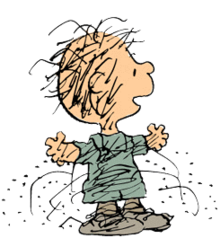
Pig-Pen from Charles' Shultz's Peanuts comic strip
Pig-Pen from Charles’ Shultz’s Peanuts comic strip

Anyway, back to Wikipedia and the rise of observational comedy – in the 50’s. Go figure. I think there must be some connection between the rise of broadcast television and comedy, but we’ll get to that later. (Oi, add this topic to the list. Dang, I have to make a place for that freaking list besides tiny fragments of post its that follow me around like the dust balls that followed Pig-Pen in Peanuts. Dang, Pig-Pen has a YouTube channel! And do you want to be really sidetracked? Read the Wikipedia article on Pig-Pen. FASCINATING rabbit hole and yes, he is a one-joke character. I think my facilitation humor is one note, but that is still an assumption that needs testing.)

The other female comic in the paper’s entertainment section was Kate McKinnon. Kate just sounds plain funny without the deep seated pain. Maybe she DOESN’T challenge us. Does that matter?

In any case, I’ve put McKinnon’s here new movie, “The Spy Who Dumped Me” on my to-watch list and I will compare with something I can find online with Weedman. Both observational comedians as far as I can tell. Or should I write comediennes?

I wondered if I should also try and do/say something funny every day of this experiment and record the reactions. I think I’ll start with cracking a joke to the grandkids while they are sleeping, just to get into the groove of it. Can that give small children nightmares?

Day 2 – August 2 – WTF?

It is 6am. What WAS I thinking. After buying the domain name I think I screwed up the DNS stuff. I know about as much about DNS as I know about comedy. There is a reason I don’t like either, right?

As I was winding down for bed my husband was watching a “roast” for Bruce Willis. On his phone, so it was a tiny, shiny, weenie roast. I walked over while brushing my teeth when I heard Demi Moore’s voice. I was interested on how she would be funny and rip him to shreds, which she did. The camera panned often to their daughters, laughing with their hands covering their mouths. Was it funny? Were they embarrassed or ashamed? Had they been raised with comedy as part of their resilience? I had no idea.

Of course when I turn to our number one resource, Wikipedia, for the low down on roasts (not the lamb, beef or pork dinner type roasts, of course,) I get an unverified article (https://en.wikipedia.org/wiki/Roast_(comedy))

“A roast is a form of American humor in which a specific individual, a guest of honor, is subjected to jokes at their expense, intended to amuse the event’s wider audience. Such events are intended to honor a specific individual in a unique way. In addition to jokes and insult comedy, such events may also involve genuine praise and tributes. The implication is that the roastee is able to take the jokes in good humor and not as serious criticism or insult, and it is seen by some as a great honor to be roasted. The individual is surrounded by friends, fans, and well-wishers, who can receive some of the same treatment as well during the course of the evening. The party and presentation itself are both referred to as a “roast”. The host of the event is called the “roastmaster”. Anyone who is mocked in such a way is said to have been “roasted”.”

My first aha. How much of the comedy I have disdained has been American? Is “insult comedy” uniquely American? To roastees really like all the mean things said about them? Ah, I can smell a learning agenda. But lest I be focused, now, every time I look at something, I see the link or connection to comedy. I have an urge to dive into the cool basement and start watching stand up shows on Netflix. Uh oh, WTF?

Footnotes:

Here are things I’m thinking I’d like to learn. This list will grow and morph. It will probably get a static page of its own!

  • About roasts, political roasts, roasts outside of the US
  • About the first women comedians and where they came from/who inspired them
  • Comedy as a political tactic
  • Comedy as a social change tactic
  • Comedy as a cause and remedy around social issues (particularly racism, sexism, homophobia)
  • Are there food comedians
  • Comedy Karaoke
  • Comedic mimes
  • Comedy as a theatre and film genre – what does it have to do with “comedy” (such as stand up comedy)
  • Religious comedy (I.e Jewish humor, Catholic jokes – I was raised Catholic)

Day 1 – August 1, 2018 – My Year of Learning Comedy

I have always been comedy impaired. Most half hour sitcoms strike me as singularly unfunny. Stand up comedy felt rude, offensive and just plain NOT FUNNY. Jokes fly right over my curly head. And as for telling them, I can never remember the punchline. Yes, comedy impaired.

I was in our 2nd hand, lovingly dented and dirty 2007 Prius, on my way to buy $5 leggings for my granddaughters (back to school!). NPR was on the radio with a story about the Comedy Museum in Jamestown, New York. (http://www.wbur.org/hereandnow/2018/08/01/national-comedy-center-lewis-black) In between calculating how many pairs of leggings and how many T-shirts I should buy, Terry Gross’ warm, intelligent voice drew me back to the radio, as she introduced the famous Abbot and Costello’s “Who’s on First” comedy routine. Lucille Ball. Dave Chappel. She then introduced Lewis Black who was giving a sneak peek into the Comedy Museum. Ha, one place I’d never go. After all, I don’t find it FUNNY. But something kept me listening. It seems the museum has a technology that builds a “comedy continuum” that helps you see which comics influenced other comics. Sort of a lineage. The museum considers the contexts for comedy and I realized hey, there was one form I DO like (James Corden’s playful Carpool Karaoke).

Hm, maybe I never liked comedy because I didn’t understand it. But there must be some tendrils that cracked the pavement of my bias to spring forth. Maybe I just didn’t UNDERSTAND comedy. My friend Viv McWaters recently did a stand up bit on facilitation that was, yes, FUNNY to me. And it must have taken a mountain of courage to do it – Viv is an introvert as far as I can tell.

For someone who claims to be an open minded learner, maybe I’ve kept the comedy window closed. Hm. I took the turn into the dark strip mall parking garage, thinking, maybe I should give it a year to learn comedy. I could learn something every day and write a blog post. Maybe I’ll turn out to be a brilliant comedy scholar. I could travel to Jamestown on a pilgrimage. Visit (gasp!) comedy clubs. Face up to how and why I find some comedy so offensive. How race and culture sets a frame on different styles of comedy.

Or maybe I might just laugh more. That would be good.

Between deciding between the sloth-knee leggings and the star knee leggings (I was weak, I bought both) I begin to imagine a book. Everyone is always telling me to write a book. Been there, done that and, to date, I have not found something that motivated me to tap the keyboard. But there just MIGHT be something here. Comedy is outside of my wheelhouse. As a facilitator, I can be very funny, but that is always about self-deprecation to put people at ease.

OOOH, maybe a screenplay. Who would play 60 year old me? Meryl Streep? (I kept thinking of women comedians, but that seems like a cheat. The lead would have to be in some way or another somewhat UNfunny.

Shut the door. No way could I study and write about comedy for a year. Every day.

Could I?

I got home, unpacked the leggings, tshirts and requisite packs of new underwear. (What says “back to school” like underwear?) Then I went upstairs and registered the domain http://myyearoflearningcomedy.com. Let’s see what happens.